


Kharg Island
Syllabus: GS1/Geography
Context
- Recently, U.S. forces struck military targets at Kharg Island in Iran.
About Kharg Island
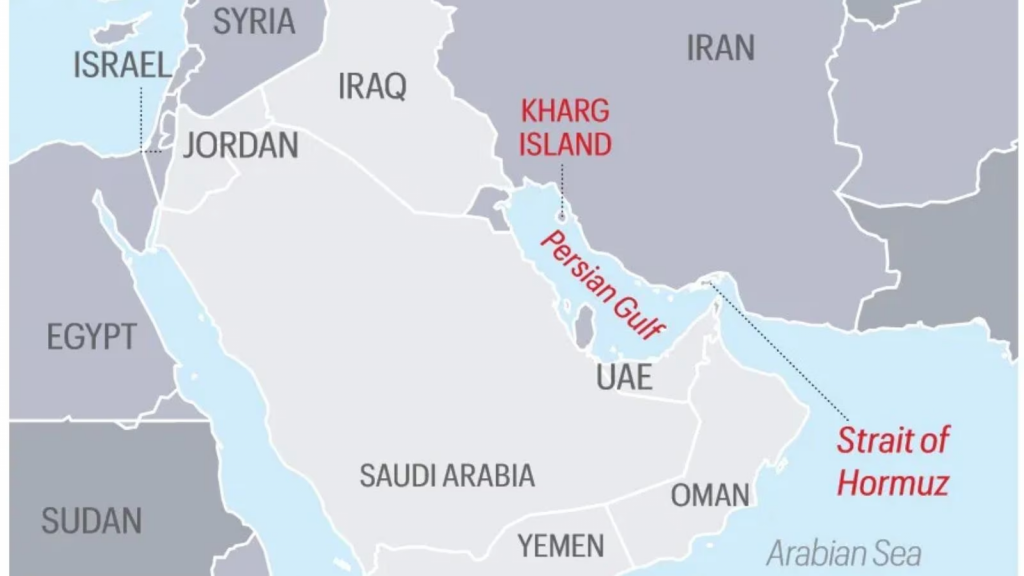
- Often referred to as the “orphan pearl,” Kharg Island is a small island in the northeastern Persian Gulf, approximately 25 kilometres off the coast of Iran’s Khuzestan Province.
- Despite its modest size, it is the single most important oil export terminal in Iran and one of the most strategically significant energy chokepoints in the world.
- Almost all Iranian crude destined for international markets is loaded here before passing through the Strait of Hormuz into global shipping lanes.
Do you know?
- Iran is the third-largest producer in Organization Of The Petroleum Exporting Countries (OPEC), accounting for roughly 4.5% of global oil supply.
- The country produces about 3.3 million barrels of crude oil per day, in addition to around 1.3 million barrels per day of condensate and other liquid hydrocarbons.
Source: IE
Autonomous District Councils in Meghalaya
Syllabus: GS2/ Polity and Governance
Context
- The election to the Garo Hills Autonomous District Council (GHADC) in Meghalaya has been postponed due to ongoing violence and disturbances in the West Garo Hills district.
About
- The Sixth Schedule (Articles 244(2) and 275(1)) of Constitution provides autonomous administrative arrangements for tribal areas in certain northeastern states like Assam, Meghalaya, Tripura and Mizoram.
- Autonomous District Councils (ADCs) in Meghalaya are special local self-governing institutions created under the Sixth Schedule of the Constitution of India to protect the political, cultural, and economic rights of tribal communities.
- These councils enjoy legislative, executive, judicial, and financial powers.
- Objective:
- Protect tribal land and customs.
- Provide self-governance to indigenous communities.
- Prevent exploitation by external groups.
Autonomous District Councils in Meghalaya
- Khasi Hills Autonomous District Council (KHADC): Based in Shillong, covering the Khasi Hills districts.
- Garo Hills Autonomous District Council (GHADC): Based in Tura, covering the five districts of the Garo Hills region.
- Jaintia Hills Autonomous District Council (JHADC): Based in Jowai, covering the Jaintia Hills districts.
Composition of ADCs
- Structure: Each council consists of 30 members. These members are called Members of District Council (MDCs).
- 29 members are elected from territorial constituencies. 1 member is nominated by the Governor.
- These members are called Members of District Council (MDCs).
- Tenure: 5 years (similar to state legislatures), unless dissolved earlier.
Source: TH
SWAMIH
Syllabus: GS2/Government Initiatives
Context
- The Special Window for Affordable and Mid-Income Housing Investment Fund (SWAMIH) has emerged as a key policy initiative for India’s Housing Sector.
About
- Launched in 2019, SWAMIH provides last-mile financing to housing projects affected by financial constraints.
- The fund is sponsored by the Ministry of Finance, Government of India, and is managed by SBICAP Ventures Ltd., a State Bank Group company.
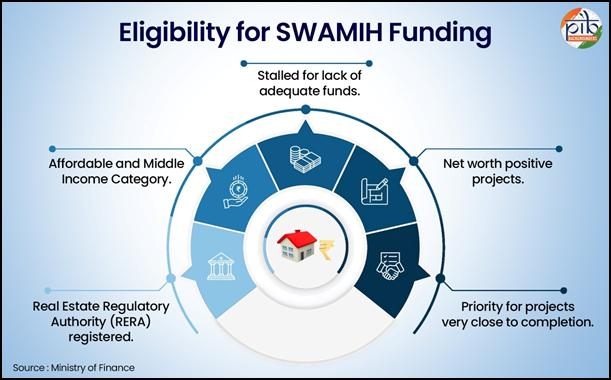
- Impact and Outcomes: Over 58,596 homes completed so far under SWAMIH, with more than 1 lakh homes expected, benefiting over 2.38 lakh people.
- Revival of projects has generated 30,000+ jobs and significant demand for construction materials.
Source: PIB
National Chambal Sanctuary
Syllabus: GS3/Environment
In News
- Recently, the Supreme Court of India took suo motu cognisance to protect the National Chambal Sanctuary from rampant illegal sand mining that threatens the habitat of Gharial.
About National Chambal Sanctuary
- It is situated in a large arc of the Chambal River, covering nearly 1800 km across Rajasthan, Madhya Pradesh and Uttar Pradesh.
- It is the first and only tri-state riverine protected area in India.
- It is a major habitat of the critically endangered Gharial.
- Besides Gharials, the sanctuary hosts a rich biodiversity of Marsh Crocodile Muggers, several species of freshwater turtles, including the endangered Red Crowned Roof Turtle, Smoothcoated Otters, Gangetic River Dolphins, Indian Skimmer, Black-bellied Tern, Sarus Crane and Black-necked Storks.
Source : TH
International Solar Alliance Reflects Power of Global Partnership
Syllabus: GS3/Environment
In News
- Recently, the Government highlighted the growing global momentum behind solar energy and ISA’s role in advancing the clean energy transition.
International Solar Alliance (ISA)
- It is a global initiative aimed at accelerating the adoption of solar energy and supporting the transition to cleaner and sustainable energy systems.
- It was jointly launched by India and France during the COP21 Paris Climate Conference 2015 under the leadership of Narendra Modi.
- It works through four key pillars: mobilising finance for solar projects, promoting innovation and digital capacity building, strengthening regional and country-level partnerships, and developing technology roadmaps and policy frameworks.
Progress and Achievements
- It has grown into a coalition of over 120 member countries, promoting international cooperation to expand solar energy, particularly in Africa, Asia, Latin America, and Small Island Developing States to improve energy access and sustainable development.
- India’s solar capacity has reached about 136 GW, supported by initiatives like PM Surya Ghar: Muft Bijli Yojana and PM-KUSUM.
Source : PIB
KC-135 Stratotanker
Syllabus: GS3/Defence
Context
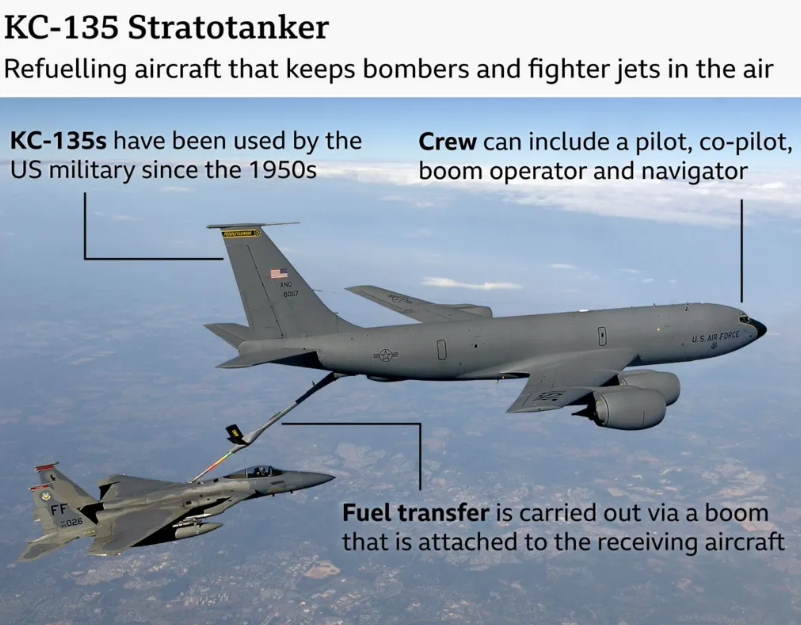
- A KC-135 Stratotanker refuelling aircraft crashed in western Iraq during an ongoing military mission Operation Epic Fury (code name mission against Iran).
About KC-135 Stratotanker
- The KC-135 Stratotanker was built by Boeing in the 1950s and early 1960s.
- It has been a backbone to the US military’s air refuelling fleet, and critical in allowing aircraft to carry out missions without having to land.
- They were used extensively in the first Gulf War to extend the range of fighter jets and bombers.
- It has a speed of 530 miles per hour at 30,000 feet (9,144 meters).
Source: TH
Global Pandemic Agreement
Syllabus: GS2/Health
In News
- India is pushing for a fair benefit-sharing framework for developing countries in the upcoming pandemic agreement negotiations in Geneva.
Global Pandemic Agreement
- It was adopted by the World Health Assembly in May 2025.
- It seeks to establish a legally binding international framework to address global gaps and inequalities in pandemic prevention, preparedness, and response.
- Its Pathogen Access and Benefit-Sharing (PABS) system is being negotiated to regulate how biological samples and genetic data are shared internationally.
- It is expected to be adopted by May 2026, will then be open for countries to sign and ratify, and will enter into force 30 days after 60 ratifications.
Source :TH
Centre sets Aside ₹57,381 crore to Address Global Headwinds
Syllabus: GS2/Governance
Context
- Centre has allocated ₹57,381 crore for an Economic Stabilisation Fund that would provide it fiscal space to address global headwinds.
About
- The total outlay for the fund is one lakh crore rupees, and in addition to the supplementary grants of over 42 thousand crore rupees, it would be added to this fund through savings of other Ministries and departments.
- This fund will allow India to respond to the recent global crisis, unanticipated supply chain disruptions, and unexpected shocks to sub-sectors of the economy.
About Supplementary Demands for Grants
- Definition: It refers to an additional funding request made by the government when the allocated funds for a particular purpose in the annual budget are insufficient or when a need arises for unforeseen expenditure during the financial year.
- It is governed under Article 115 of the Indian Constitution and requires the approval of Parliament and the necessary funds are drawn from the Consolidated Fund of India (CFI)
- Types of Supplementary Grants:
- Supplementary Grant: For additional funds over and above the amount approved in the annual budget.
- Excess Grant: Granted when money spent exceeds the amount sanctioned in the budget.
- Token Grant: A small sum (₹1) is sought for the Parliament’s approval to reallocate funds within different heads of accounts.
- Advances from Contingency Fund: For meeting urgent, unforeseen expenditures, later regularized through supplementary grants.
Source: TH
Previous article
Seafarers Abandonment
Next article
UPSC’s New Rule on Appointment of State DGPs
